


Maybe I’m a xenophile. Or a mystic Christian. Or a curious Black cat lingering in the bushes and unfamiliar alleys. I’ll never truly know. And honestly, it doesn’t even matter if I never knew. Instead of continually drinking the cough syrup of rigid religiosity, I find myself wide open like a Toucan, peeking into sketchy ass caves. Here I am asking questions from strangers on Beyoncé’s internet and galloping down rabbit trails hoping to get lost in something ethereal. Something cosmic! Lift the veil from my eyes, Mother Earth, so I can see the Universe. This is one of those rabbit holes I went down, and I must say, I found something that made me double take.
Child, What Else Is Going On?
One day back in 2023, I sat at home wondering what religions my ancestors from Africa may have practiced. To be honest, until I left the church I had been part of for nine years, I didn’t know much beyond the Southern Baptist Church. My family is Baptist, and that is the kind of church I helped plant. For years, I loathed being black, asked people to call me brown, and just hung around lots of white people. Later, I learned subconsciously I did that because I hated myself.
Once I temporarily stepped outside of that world of Protestantism, though, I wanted to learn more. I read books about Buddhism, researched atheism and Eastern philosophy, and started looking at spirituality without feeling like I was going down the wrong path. Eventually, I started wondering about Africa, the hometown that I’ve never stepped foot onto. According to ancestry.com, my lineage is rooted primarily in Cameroon and the Benin-Togo region. I mean what else do I have to go off of?
So I had a general question: What might some of my ancestors have believed?
I probably Googled it first. Then, because Amazon has a gang of audiobooks, I searched there too. Finally, my curiosity introduced me to Yoruba traditions, Ifá, and an entire spiritual world I knew almost nothing about. I found Yoruba Spirituality for Beginners by Kara Lawrence and began reading about the Orishas.
At first, I wasn’t even sure what to call them. Are yall girls Spirits? Gods? Angels? Intermediaries? Child… The more I read, the more those titles sounded inadequate. Within Yoruba religious traditions, the Orishas are divine beings connected to nature, human experience, and morality. But they also uplift ancestry, destiny, healing, and communication with the supreme creator, Olodumare. Ain’t no English word for that. Truth be told, ain’t no Christianese word for it either. The entire cosmology intrigued me.
Not only did I read that book but I watched YouTube series on the Orishas, specifically The Blaque Witch Yaya channel. I listened to music clips that echoed their presence. The deeper I went, the more enraptured I felt by how the Orishas contain philosophy, history, and explanations for how a person should move through life. But among all of the Orishas I encountered, one kept staring at me through the fog: Eshu.
So Who Exactly Is Eshu?
Eshu, a primordial Orisha, acts as a divine trickster, is an agent of change, and is a figure associated with crossroads! I’m not talking Bone Thugs-N-Harmony. Think doorways, conflict, uncertainty, communication, and choice. Being on the cusp of making a decision that could change the course of ya life, honey! Been there?
If Eshu out here tricking folk, does that mean Eshu is evil?
What REALLY got me though is Eshu is also frequently described as a trickster, which immediately got my attention because I love a complicated character. I mean hello, Depth! Maybe it’s because I’m in my “I need distance from everything that’s religiously familiar” phase but stay with me. One of the reasons Eshu interested me so much is that this Orisha does not fit comfortably inside the Christian good-versus-evil framework I grew up with. Christian missionaries historically made this problem worse by translating Eshu into the language of Satan and the Devil, literally flattening a much more complex Yoruba figure into something recognizably evil within Christian theology. You know, fitting what’s uncomfortable for them into a box they could spoon-feed to their members’ mouths.
Little do they know, Eshu is NOT the Yoruba Devil. Imagine a visitor walks into YOUR house, rearranges YOUR furniture, then tells you that you need an interior decorator. Baby, this ain’t your house! You cannot simple compress any Orisha to evil or good! Someone that can create disruption, test people, expose character, and force someone to make a choice isn’t causing trouble. Eshu is associated with communication and interpretation, and he appears wherever change or conflict becomes possible, including the crossroads.
The Tale of the Two Farmers
One famous tale involving Eshu tells of two best friends who farmed neighboring plots of land separated by a path. They shared a deep, unbreakable bond and promised to remain friends forever. One day, Eshu walked down the path between their farms. His face was painted red on one side and white on the other, although some versions of the story say he wore a hat painted a different color on each side.
Each farmer saw only one side of Eshu. When they later talked about the stranger who had passed, they began to argue. Both were convinced of what they had seen, and eventually they started calling one another liars.
Eshu returned and showed them that both were “right” based on their specific vantage points. Neither farmer had seen the whole picture. Their narrow perspectives were not the whole story.
Hmm.
If a spiritual force pushes you to face the crossroads you’re on and see things differently, I find that truly divine, not demonic. Eshu reminds me of the kind of character you sometimes need in a book or movie to bring everyone to a point where something has to be confronted, understood, or decided.
Where Have I Seen this Kind of Character before?
So of course, being a writer, my next question became: Where have I seen this kind of character before? I’m not fully done with that question yet, and honestly, I don’t need to be. I’m still learning about Eshu, the Orishas, Yoruba traditions, and everything else waiting farther down this particular rabbit trail. I would rather tell you what I actually know and what I’m genuinely curious about than pretend I somehow became an expert because I read a book and watched some YouTube videos.
I’m more curious about your corner anyway. You heard of Eshu or the Orishas before? What comes to mind for you after reading this? Maybe you know something I don’t. Maybe you see something completely different from your side of the room. Either way, tell me in the comments.
What do you see from your corner?
Images of Eshu
Below are a few artistic renderings of Eshu that caught my attention while I was learning. These are not definitive representations. I am just sharing them as interpretations.
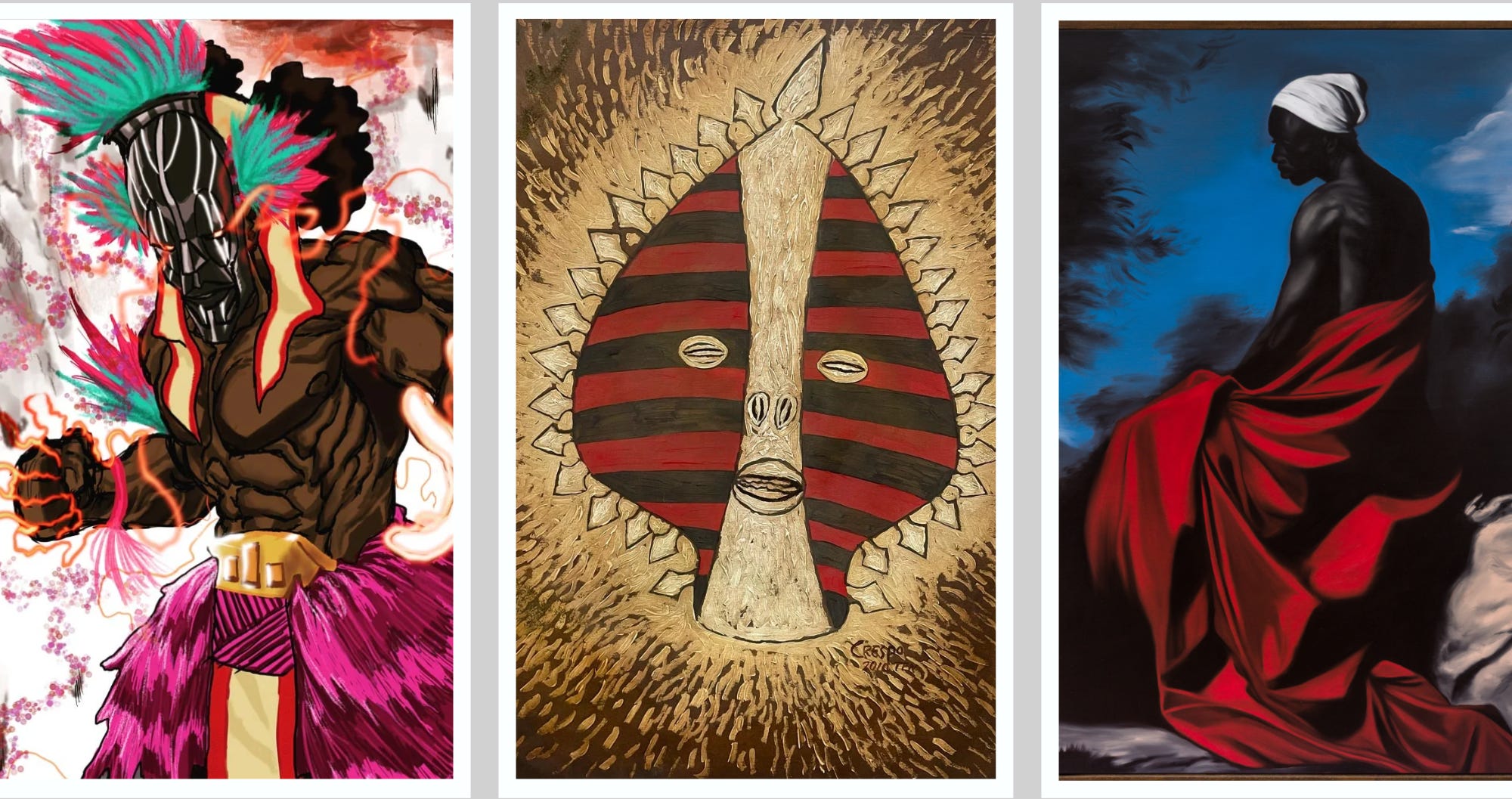
Enter Eshu
Artist: Sketch3K of Maafa Comics
Eshu Laroye
Artist: Francisco Crespo
https://crespoartstudio.com/product/eshu-laroye/
Eshu (2025)
Artist: Gustavo Nazareno
https://artplugged.co.uk/painting-faith-gustavo-nazareno-and-the-recasting-of-the-orixas/